About


I study how humans represent, remember, and navigate space across real and virtual environments. My work bridges
spatial cognition; aging; VR; human-centered design with mixed-methods: behavioral tasks, immersive VR, and qualitative interviews.
Department of Psychology, University of Florida · Behavioral & Cognitive Neuroscience (Ph.D. candidate).
Research
Research Interests
Spatial cognition across the lifespan
Age-related differences in spatial memory and wayfinding strategies.
Navigation across modalities
Comparing immersive/desktop VR with real-world navigation; role of global reference cues.
Human-centered spatial design
Architectural affordances and environmental cues that improve wayfinding.
Methods
Mixed-methods (behavioral + qualitative), Virtual Silcton, SBSOD, task design.
Publications & Selected Works
-
This is not the way: global directional cues do not improve spatial learning in an immersive virtual environment
-
Newly trained navigation and verbal memory skills elicit changes in task-related networks but not brain structure
-
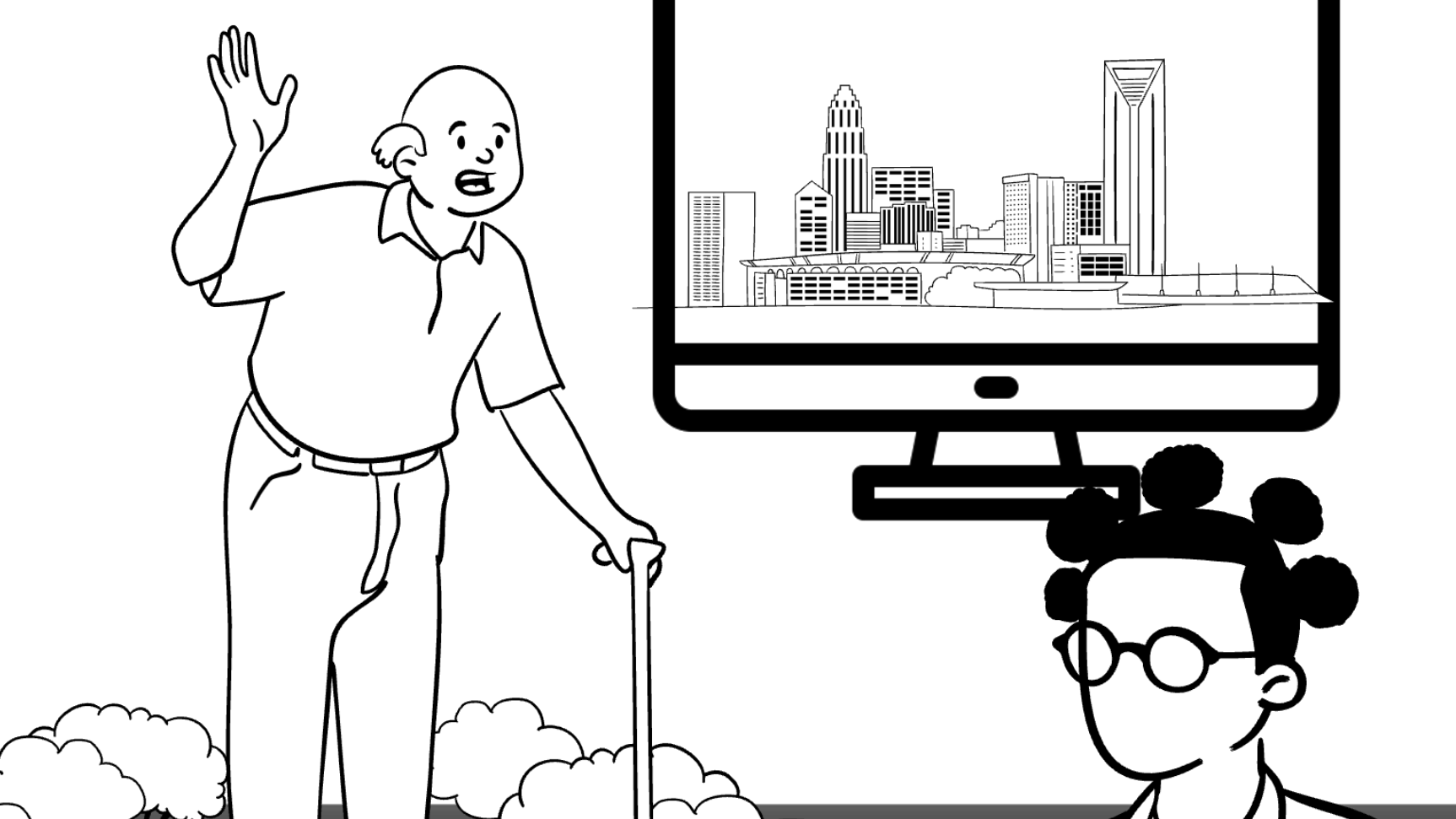
Lost in (Virtual) Space? Age Differences in Spatial Navigation in Real-World and VR
Qualifying exam review · under revision
Future Research Directions
Aging & Virtual Reality
Investigate how age-related differences influence spatial navigation and memory using VR and mixed-methods.
Human-Centered Spatial Design
Develop evidence-based principles for navigation-friendly, human-centric spaces.
Projects
PhD Dissertation: Age differences in spatial navigation across real and virtual worlds: A mixed-methods approach
AgingSpatial NavigationVirtual Silcton
Mixed-MethodsInterviewsDesktop VR
Click card for details
PhD Dissertation
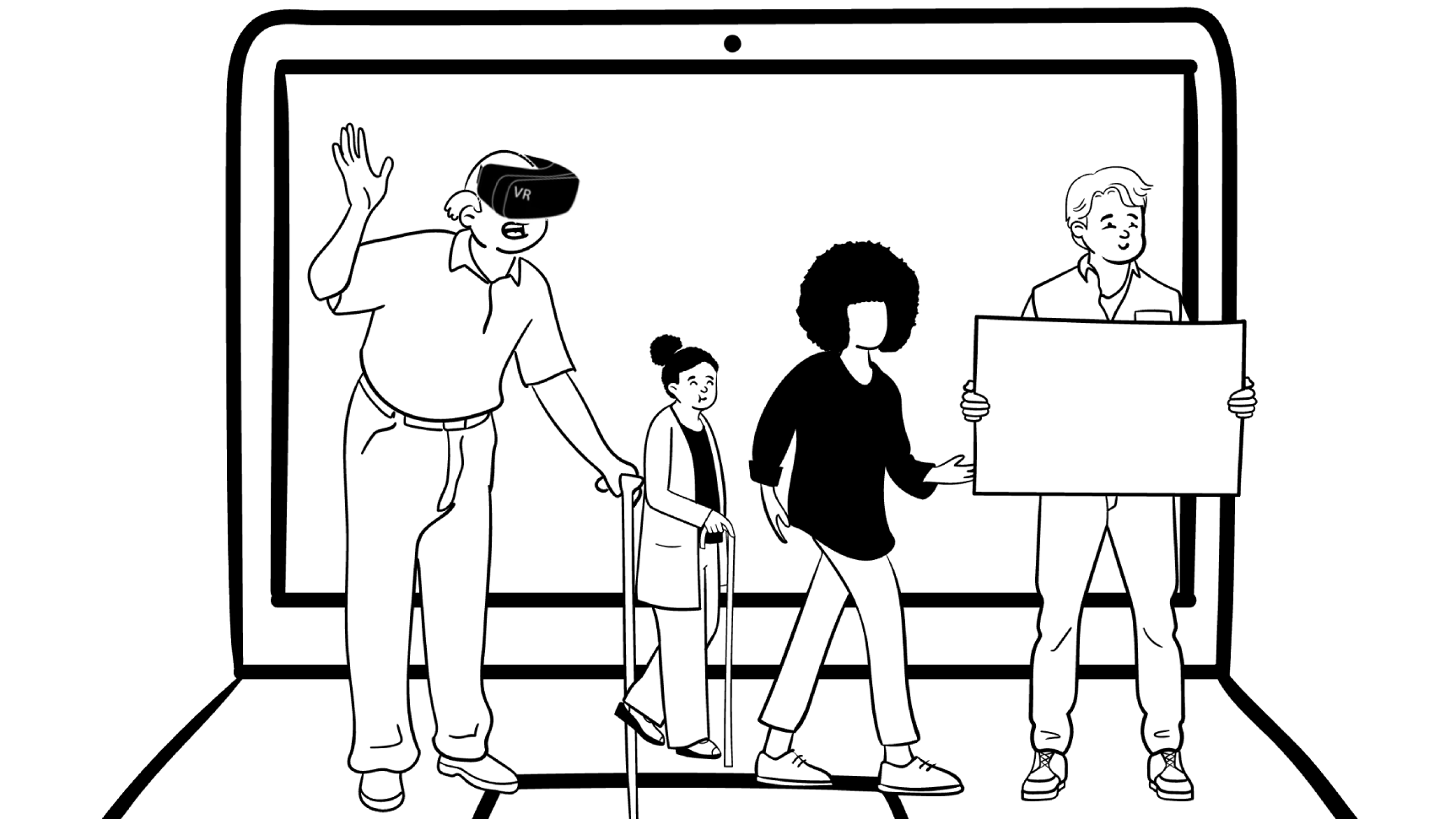
Abstract. Navigating and learning new virtual or real-world environments can be challenging for anyone, especially older adults. This study will investigate age-related differences in navigation strategies across both real-world and desktop virtual environments, employing a mixed-methods approach to explore qualitative and quantitative aspects of navigation ability. Participants, including younger adults (18–25) and older adults (55+), will be interviewed about their real-world navigation habits, complete Virtual Silcton on desktop, and talk about their spatial learning strategies during the virtual task. Thematic analysis of interview data (semi-structured interviews) will reveal key differences in wayfinding approaches, while quantitative measures will examine individual differences in navigation performance. By comparing real-world and VR navigation strategies, this study aims to uncover how age and individual differences influence spatial behavior across different modalities. Findings will inform the design of age-inclusive navigation aids and training interventions to support spatial orientation and mobility in aging populations.
↺ Back
This is not the way: Global directional cues do not improve spatial navigation in an immersive virtual environment
Immersive VRVirtual SilctonNavigation CuesWayfinding
Click card for details
Global Directional Cues in Immersive VR
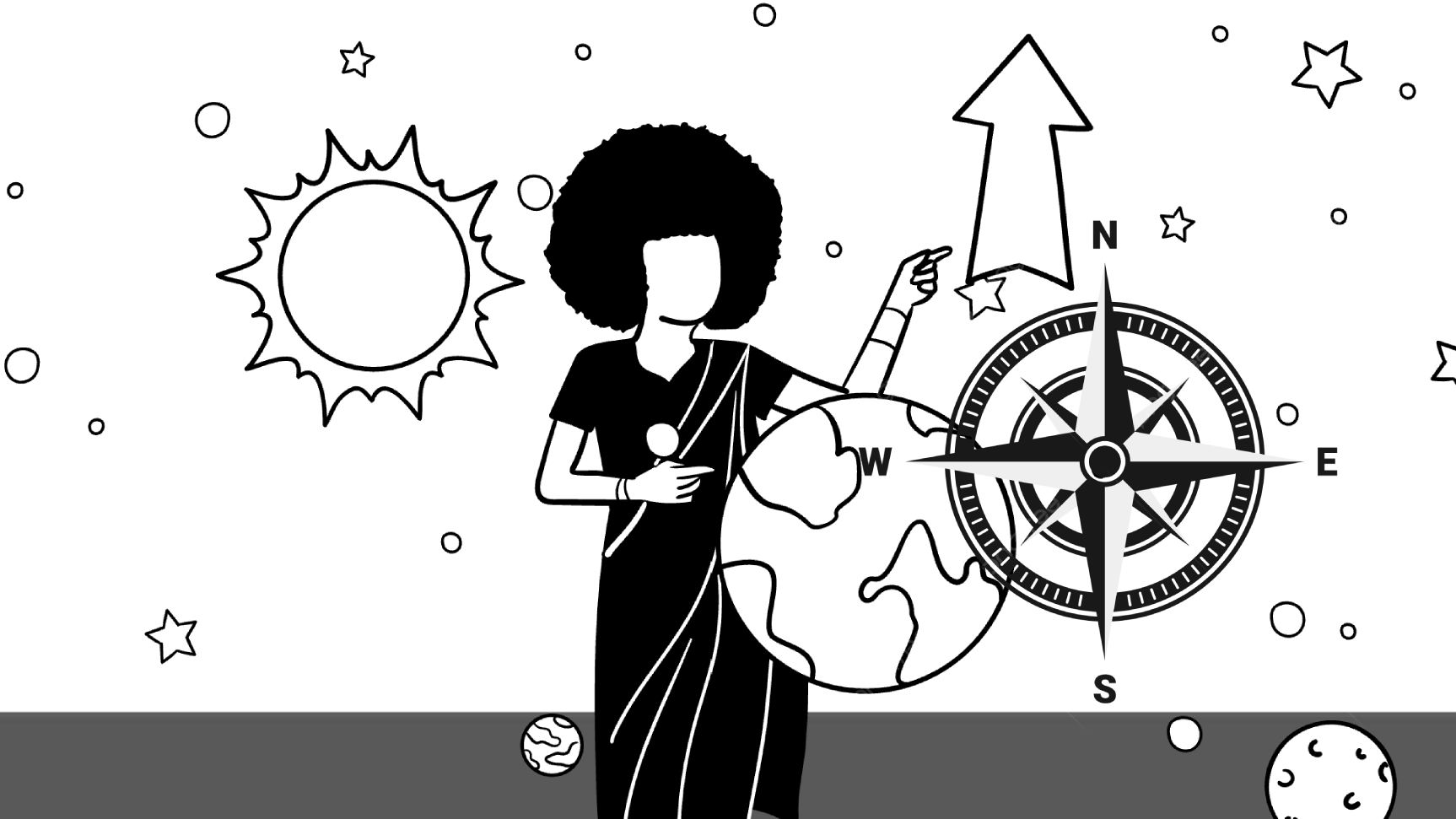
Navigation tools, like maps, compasses, and GPS devices are common in daily life. But do they help us learn large-scale spaces more easily? Given that self-report data are not fully ecologically valid in spatial cognition studies, we use cutting-edge technology to create more plausible and controlled environments to investigate our spatial abilities.
In this line of research, we are investigating how effective navigation tools can be and ways to improve them. For instance, although a compass provides the same sort of directional information as other distant visual cues (like a mountain range to the West), is either actually used to learn an environment more easily?
To answer these questions, we are using a virtual reality head-mounted display (HTC Vive) and an omnidirectional treadmill (Virtuix Omni VR) to create an immersive virtual environment (VE). Our participants walk on the treadmill and learn a widely-used virtual environment (Virtual Silcton) with or without various navigational cues. We then test whether they use these cues to aid in learning their surroundings and perform better on tasks that tap their large-scale spatial knowledge. This work will inform future approaches to improve and support spatial navigation behavior across individuals with vastly different spatial navigation abilities.
↺ Back
Navigating the Metaverse: The Relation Between Scale And Expertise In Spatial Knowledge Of Immersive And Desktop Virtual Reality
Immersive VRDesktop VRVideo GamesSpatial Scale
Click card for details
Scale & Expertise in VR Navigation
Throughout evolutionary history, people navigated in real three-dimensional environments. In relatively recent times, desktop virtual reality (VR) and cutting-edge technologies like immersive VR are becoming accessible. Although some studies have shown similarities between real and virtual navigation, our understanding of individual variability in VR spatial knowledge has been limited.
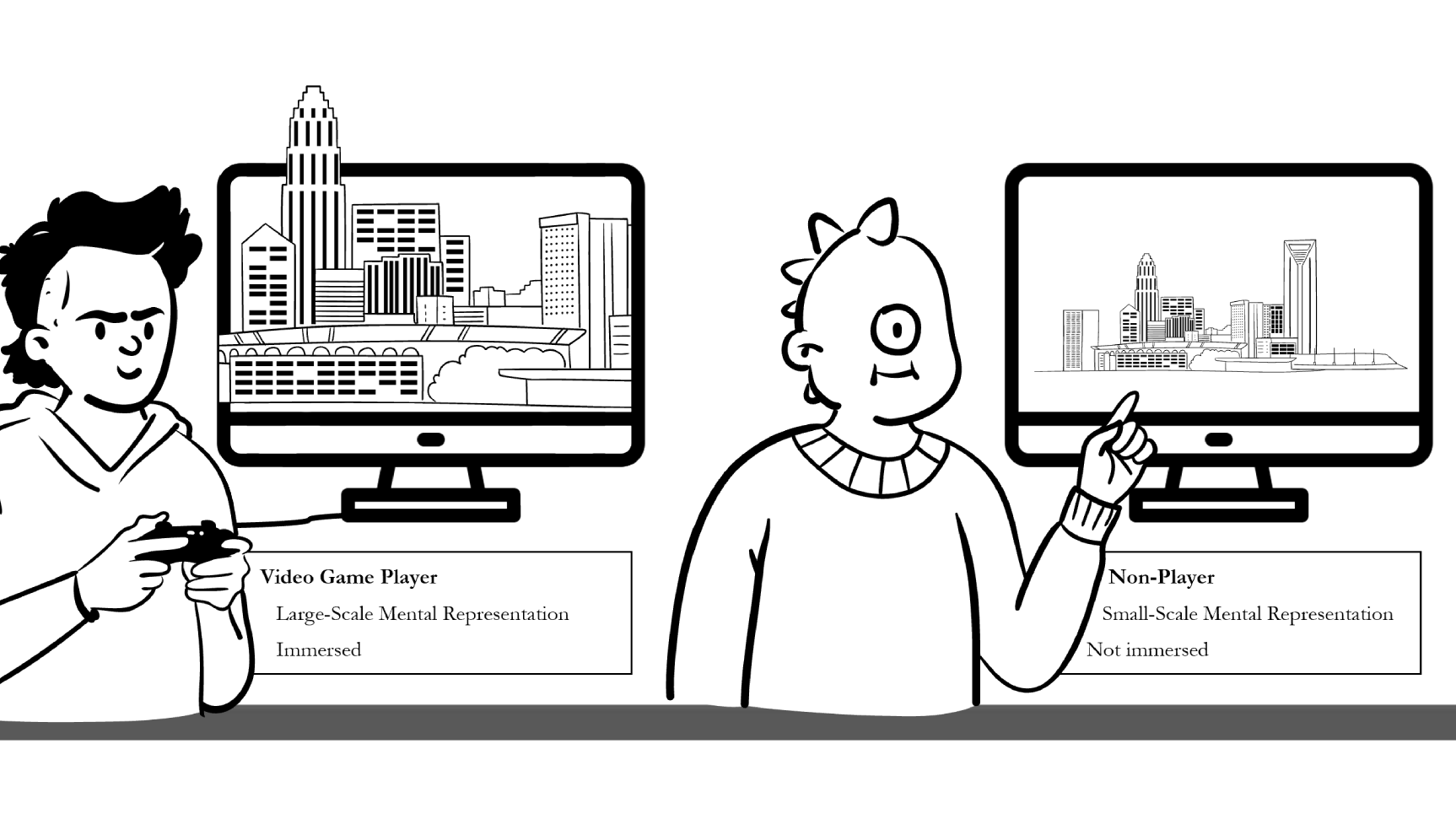
Desktop VR research supports that playing video games is associated with cognitive advantages like increased attention, visuospatial abilities, and spatial navigation skills. However, what accounts for video game players' improved spatial navigation ability is unclear.
Here, we examine the relationship between video game experience, immersion, and spatial navigation ability. Our central hypothesis is that variations in the mental representation scale of environments account for the navigation performance differences between video game players and non-players. We will use a within-subjects quasi-experimental design, testing video game players and non-players in immersive and desktop VR. Participants will learn large-scale environments and get tested on their spatial knowledge and a new measure allowing inference on the scale of spatial representations. This work will be the first to investigate a mediated relationship between video game play and navigation through mental representation scales and uncover the processes behind the well-studied direct correlations.
↺ Back
Lost in (Virtual) Space? Age Differences in Spatial Navigation in Real-World and Virtual Reality
AgingReviewVR vs RealIndividual Differences
Click card for details
Age Differences in Real vs. Virtual Navigation
For eons, people have navigated through real-world three-dimensional environments. With the advancement of technology, we can simulate three-dimensional navigation in virtual reality (VR). Navigating and learning new virtual or real-world environments can be challenging for anyone, especially older adults. Age-related differences in spatial tasks have been well documented.
VR has become a popular tool in the field due to its ability to create well-controlled environments and enhance external validity. However, the extent to which VR can reliably measure navigation abilities and age differences remains unclear. This review will explore the theories behind why these differences might be amplified in some cases and for some people while attenuated in others.
↺ Back
Education
-
Ph.D. (in progress) — Behavioral & Cognitive Neuroscience
University of Florida · Spatial Cognition & Navigational Neuroscience Lab (Advisor: Steven M. Weisberg)
-
M.S. — Psychology
-
B.S. — Psychology
TOBB University of Economics and Technology, Ankara, Turkey
-
B.Arch — Architecture
TOBB University of Economics and Technology, Ankara, Turkey (Merit-based scholarship)
News & Awards
News — Timeline
November 2025
Graduate Conference Award ($750)
Psychonomic Society — 66th Annual Meeting, Denver, CO.
May 2025
Jacqueline Goldman Spring Scholarship ($8,000)
Department of Psychology, University of Florida — supports my dissertation project.
April 2025
The Balkhi Experiential Learning Award ($500)
Department of Psychology, University of Florida.
Selected Awards
Jacqueline Goldman Spring Scholarship
2024, 2025
Psychonomic Society Graduate Conference Awards
2023, 2025
UF Graduate Student Travel Awards
2023, 2024, 2025
Certificate of Outstanding Merit
UF International Student Achievement Awards (2022)
Personal
Interests & Aesthetics
Design-forward
I love well-designed things. Minimalist & modern architecture speaks to me. Black is my favorite color.
My companion
Meet Nova Bean, my purr-fect tuxedo cat. Statistically speaking, his purring-to-petting correlation is a flawless r = 1.0.
-
Photography
High-contrast, black-and-white frames.
Currently
Learning
Qualitative methods: thematic analysis.
Teaching
Making Intro to Psych more interactive, applied, and inclusive.
Values
-
Teamwork & Impact
I feel fulfilled by creating human-centered impact — on people, students, spaces, research practices, and navigation.
Fun Facts
-
Mentor
I run a YouTube channel for students in Türkiye considering PhDs in the US; I’ve mentored 10+ students so far.
-
Name hack
If you’re wondering how to say my name, my Starbucks name is AJ—at this point, I answer to both ¯\_(ヅ)_/¯.